New hires learn by getting it wrong
Weeks of shadowing before a sorter is trusted on the belt alone, and every route change starts that clock again.
Point the phone at the label. PackSort names the driver and bay in about a second, on the device, with no map to learn and no veteran to ask. When a postal code is shared between routes, it asks for one more character instead of guessing.
 Free on iPhone. Sign in with the account your depot issues.

On the phone, before the first package
Vancouver Island and the Gulf Islands, from licensed open data. No lookup service to wait on.
The problem
Today a sorter reads the address, pictures it on a map and remembers which driver covers that area. The depot is only as fast as what the people on shift happen to know.
Weeks of shadowing before a sorter is trusted on the belt alone, and every route change starts that clock again.
"Ask Dave, he knows the north end." When Dave is sick, on holiday or gone, the north end slows down.
Hours later, with no record of who sorted it, what they saw, or why. The package goes back on the belt and nobody learns anything.
The film · 0:30
The label is read, the address resolves on the phone, and the driver's bay lights up. Made from the app's own island map and its demo depot, with an original score.
How it works
The camera reads the barcode and the address block together and resolves them on the phone. Nothing is typed unless a label is unreadable, and then the fallback is two characters, not an address.

The camera is off until the sorter starts it. Hold the label steady for about a second; the app reads the barcode and the destination block together.

Name, bay and the driver's area on a map, in large type readable at arm's length. Resolved on the phone in about two milliseconds.

Type or say the two characters after the province letter. The keypad only offers characters that exist; voice only hears the 37 valid tokens.
Try it
Every BC postal code starts with V, so it carries no information. The next two characters identify one of the island's 37 postal areas, and most areas belong to one driver. Tap two keys.
Demo depot with three fictional drivers. Your depot's routes replace these.
What it buys you
The resolver takes 2 ms. The rest is the sorter's hands. Speaking an address takes 3.5 to 6 s; two characters take under one.
An unknown code says so. A fallback answer is flagged and logged so a mis-sort can be traced instead of vanishing.
Codes with no written rule take the route of the addresses around them. Measured leave-one-out on 16,501 real addresses where neighbours agree.
"Odd side or even?" is one tap. Only where numbers genuinely interleave does the app ask for the street.
Figures from the reference depot configuration: 15 routes, 16 drivers, 187 street rules, 114 named consignees. Details in the engineering notes on request.
The hard cases
Zone maps break on the cases a real depot has every day. PackSort was built on those cases rather than around them.
When an area is split between drivers, the app reads further into the code and only offers characters that actually occur. It never concludes early from a partial match.
Draw a boundary and PackSort finds every street it crosses, reads the real civic numbers and proposes a written rule for a person to confirm. Where numbers interleave with no clean rule, it says "always confirm" rather than inventing a line.
Big receivers carry outsized volume and often ship without a usable code. They sit as tiles on the first screen and narrow the moment a digit is tapped.
One route on the reference floor is worked from two bays. Nothing on the board says where one half ends, so PackSort names the route and flags the bay. Picking one would be the mis-sort this app exists to prevent.
A sorter holding the package outranks any inference. A correction made on the floor is recorded and consulted first, and lives beside the configuration so a new import can't silently discard it.
Input, level reached, driver, latency and flag, for every package. Exports as CSV when a supervisor asks for it, because a mis-sort is usually noticed hours later.
Setup
A supervisor types or pastes each driver's route sheet as it's already written: "1600 Government St and up", "300–700 Bay St", "Douglas St even side". PackSort turns it into a checked boundary. Publish it once and every phone on the floor follows.
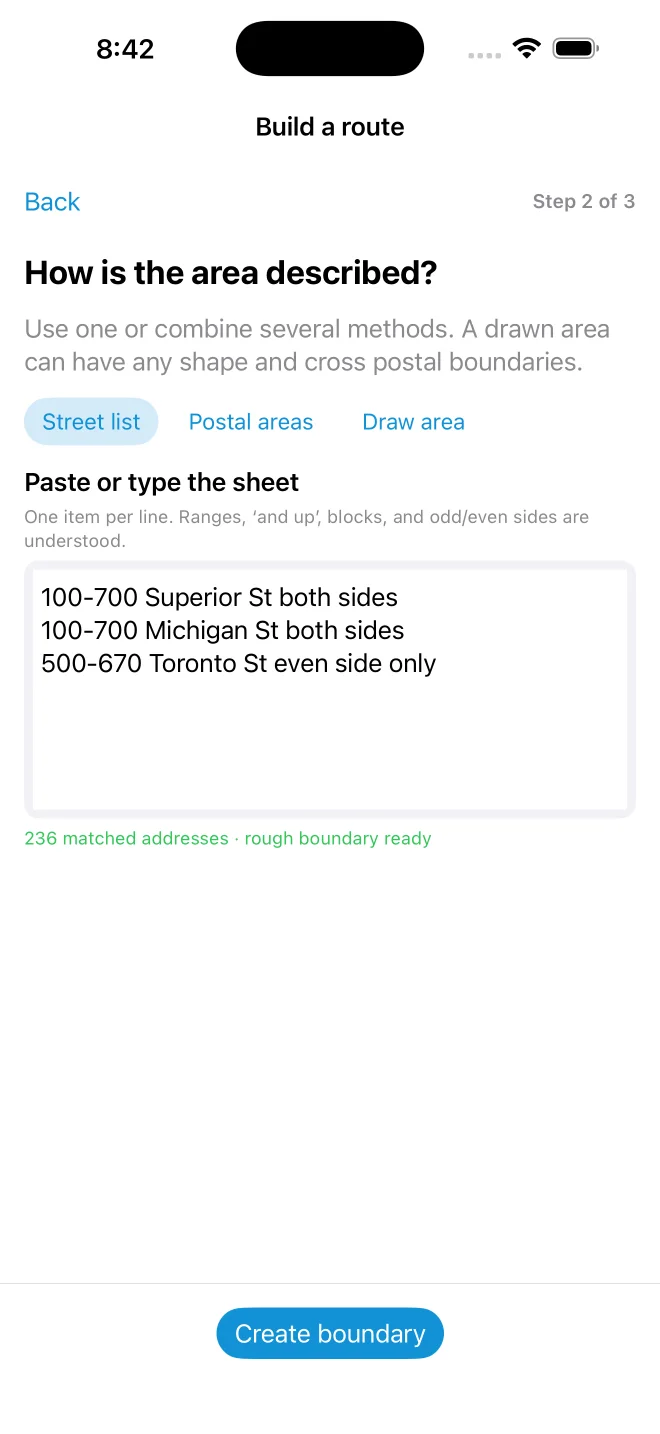
Ranges, "and up", blocks and odd/even sides are understood as written. Or tap postal areas on a map.
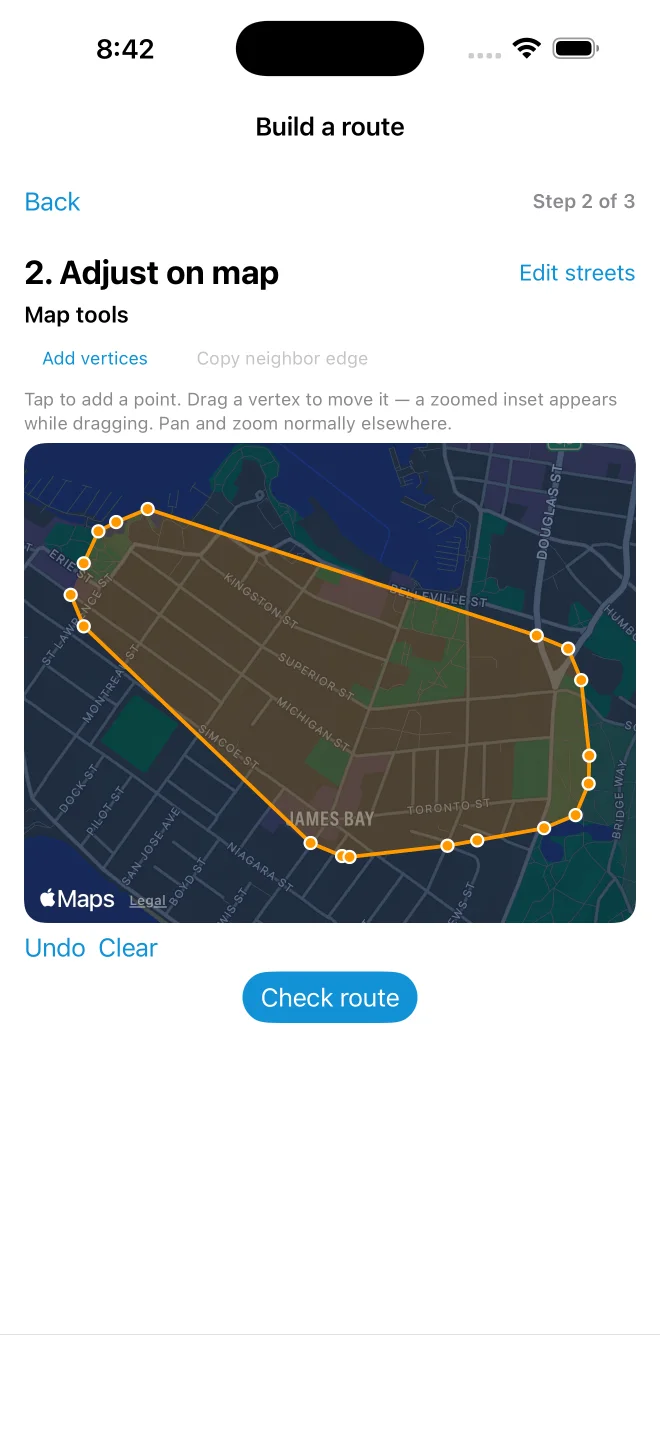
Drag a vertex, copy a neighbour's edge, snap to the road. Split streets are detected and proposed as rules.
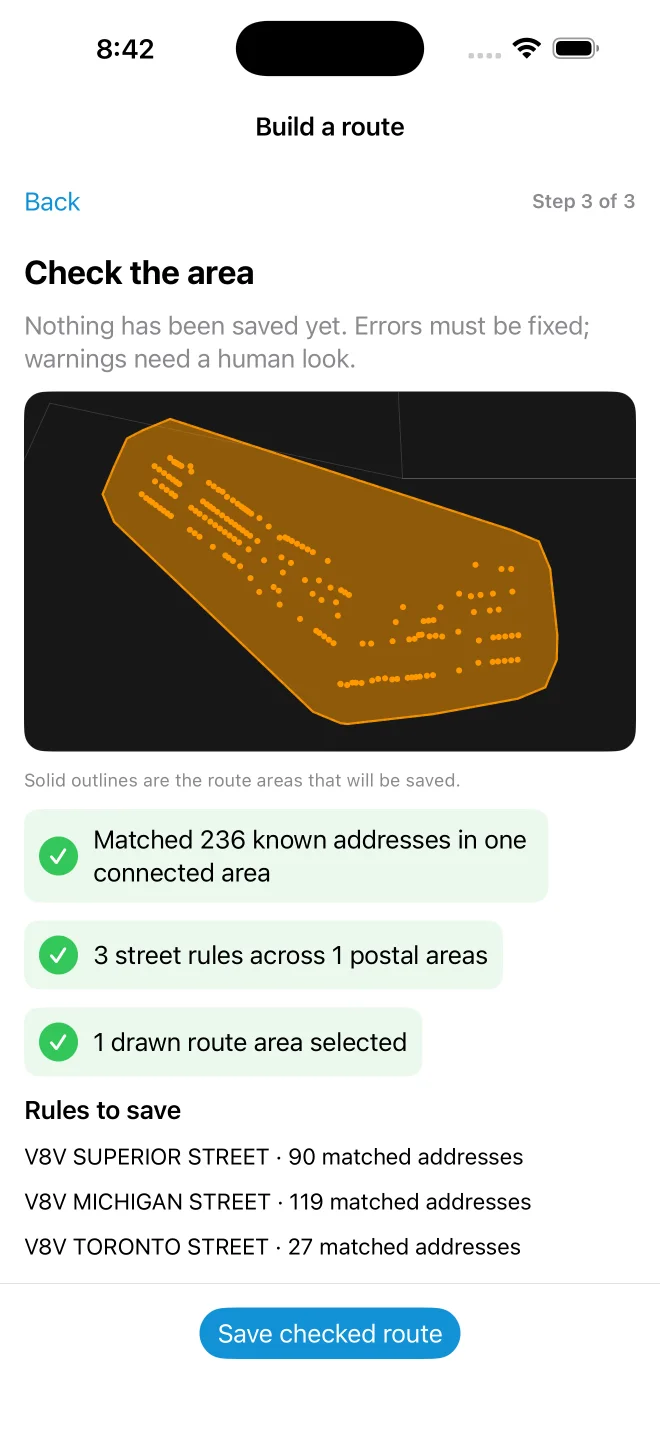
Nothing is saved until it passes. Errors must be fixed; warnings get a human look. Then one tap publishes to every phone.
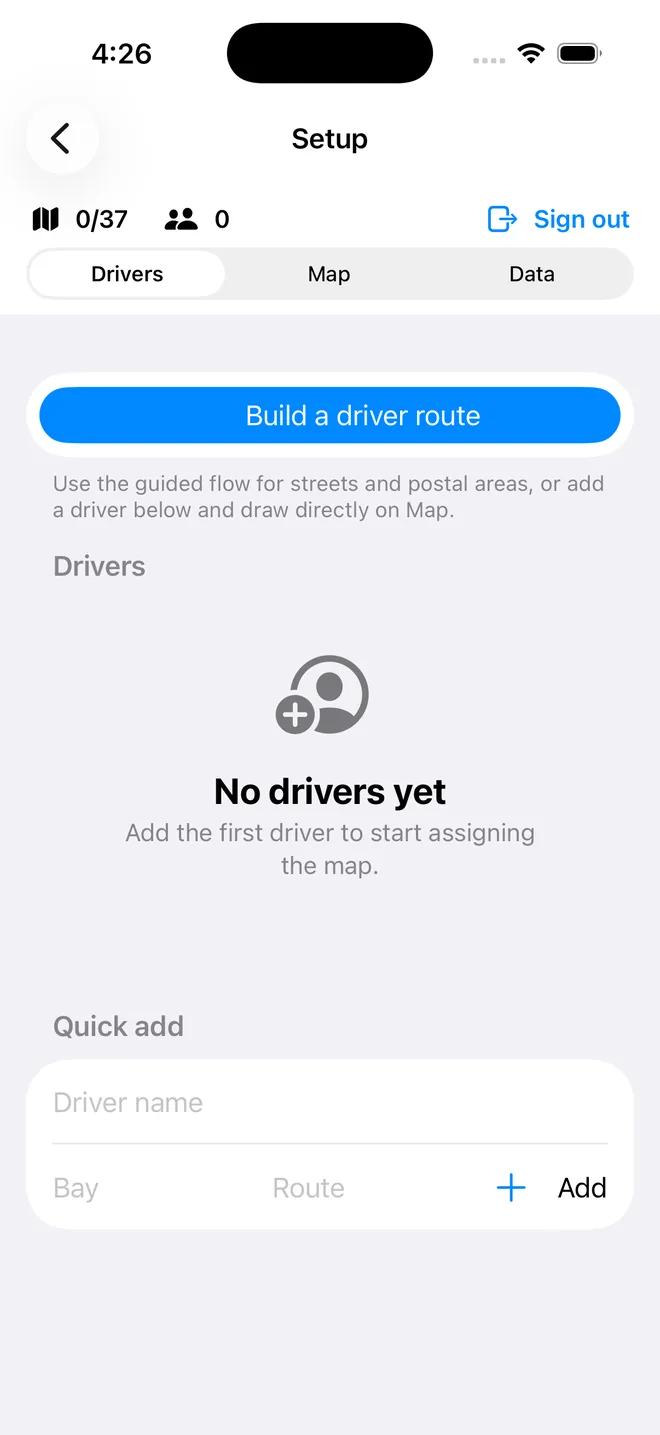
Name, bay, route. The roster starts empty and fills from the same screen that builds each driver's route.
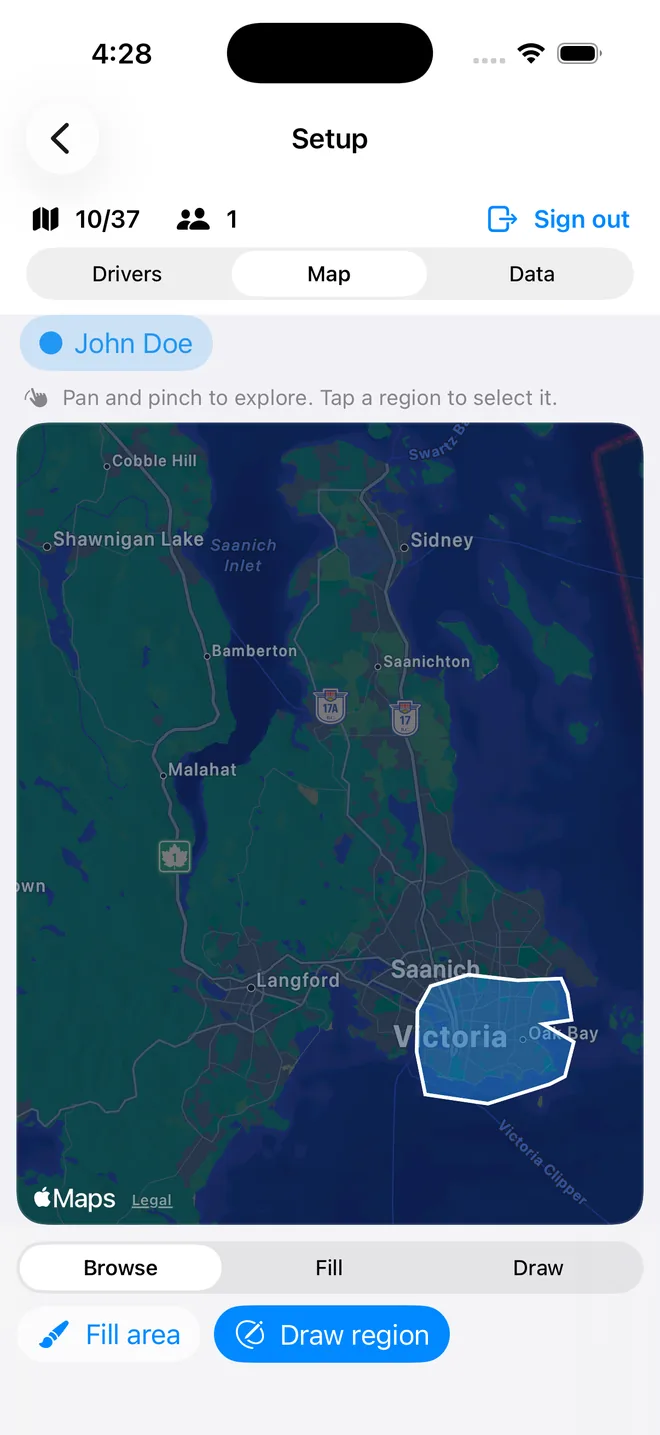
Browse, fill or draw. Every published area is on the map, so a gap or an overlap is visible before a package finds it.
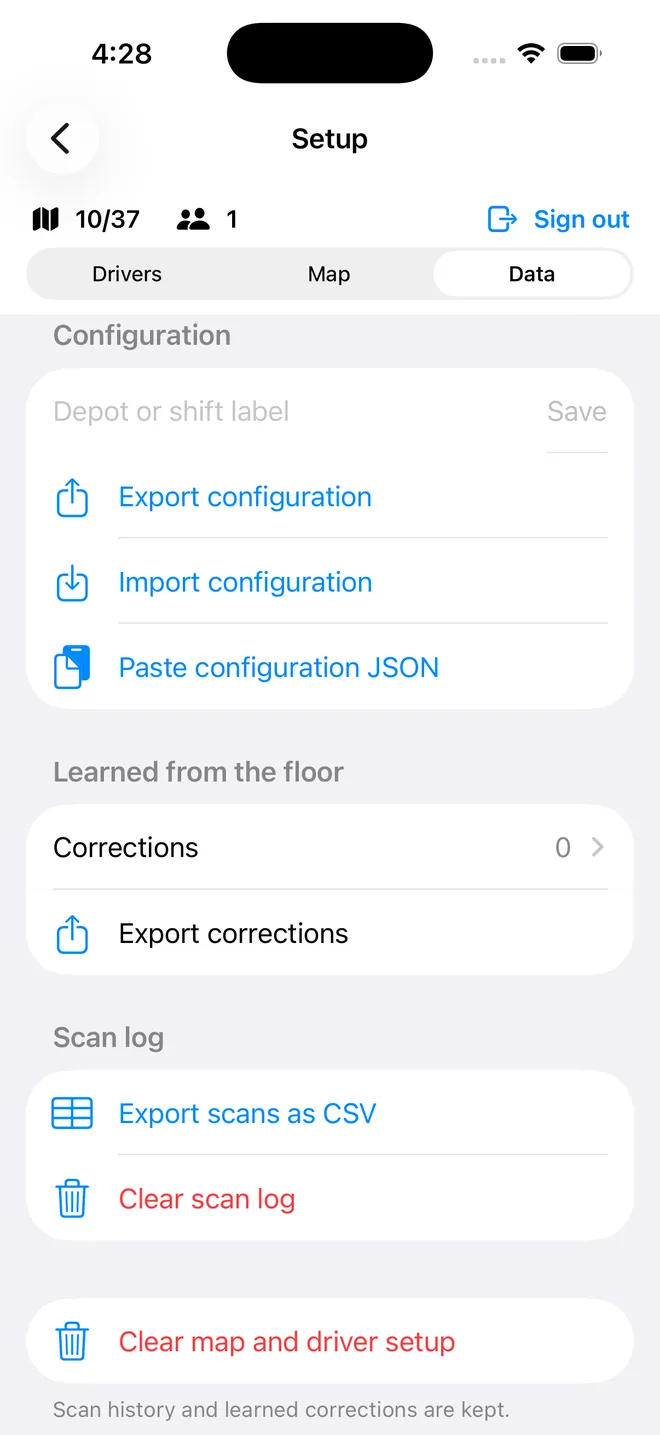
The configuration is one file to export or import. Corrections learned on the floor and the CSV scan log live here too.
The depot's routes are one file. A floor can mix iPhones and Android phones and every one gives the same answer.
A driver leaving and someone taking the route over is a rename. Every area, rule and code follows the record.
If the rules an area was built from have moved on, that area falls back to the street path and Setup says what needs a rebuild.
Built for the whole floor
Get the answer, not the homework.
Write the routes once. Review what the floor flags.
Faster onboarding, traceable mistakes.
Trust
The routing engine makes no network calls. Addresses, streets and postal codes ship inside the app. Scan logs and corrections stay on the device and export only when a person chooses to.
Sorting needs no signal. Access is checked when it can be, with an eight-hour grace period if the floor loses connection.
StatCan boundaries, municipal address feeds, OpenStreetMap and GeoNames — all with redistribution terms, all acknowledged in the app.
PackSort routes from the destination on the label. It stores no consignee database of yours and no package history beyond the scan log you control.
Accounts are created by the depot administrator. Sorters see the sort screen; supervisors see setup; nobody registers themselves.
Questions
No. Addresses, streets, postal codes and the map geometry ship inside the app, and the resolver never makes a network call. The app checks the account's access when it can and keeps working for eight hours without it. The only online part is the supervisor's map tiles when drawing routes, which happens at a desk.
The sorter types or says the two characters after the province letter. The keypad shows only the characters that exist in your depot's coverage, and voice recognition is constrained to the valid tokens, so it cannot hear something that isn't a postal area. The postal-area keypad path is the original design; scanning was added on top of it.
It keeps reading. The app asks for the next character of the code, offering only characters that occur, until the remaining codes agree. If the full code is still ambiguous it asks for the street or civic number. Where one question settles it — odd or even side — it asks that instead. It never concludes from a partial match.
Any system can. What PackSort will not do is be wrong silently. An unknown code says "unknown". A fallback answer is flagged on screen, kept in red in the recent strip and recorded in the scan log with its reason. A sorter who knows better taps "Wrong driver?" and that correction is consulted first from then on.
A supervisor with the route board in hand can enter a route in a few minutes: paste the sheet, adjust the boundary, check it, save. A fifteen-route depot is an afternoon. Corrections and refinements happen on the floor afterwards without a redraw.
Vancouver Island and the Gulf Islands ship in the app today: 37 postal areas, 277,776 addresses. Other Canadian regions are supplied as reference packs per deployment. Tell us where your depot is.
iPhone and Android, with one shared configuration. The full sorting workflow and the route builder are on both, so a supervisor can draw a route on either and every phone reads it. PackSort is on the App Store; Android builds are issued to depots directly.
Routing inputs and logs stay on the device and export only when a person chooses to. Sign-in uses Firebase Authentication, which processes account credentials and ordinary connection metadata. PackSort keeps no package history and no consignee database of yours beyond what you type into the route board.
See it on your belt
A floor demo takes an hour: we enter two of your routes, hand the phone to a new sorter, and time it against your best one.
